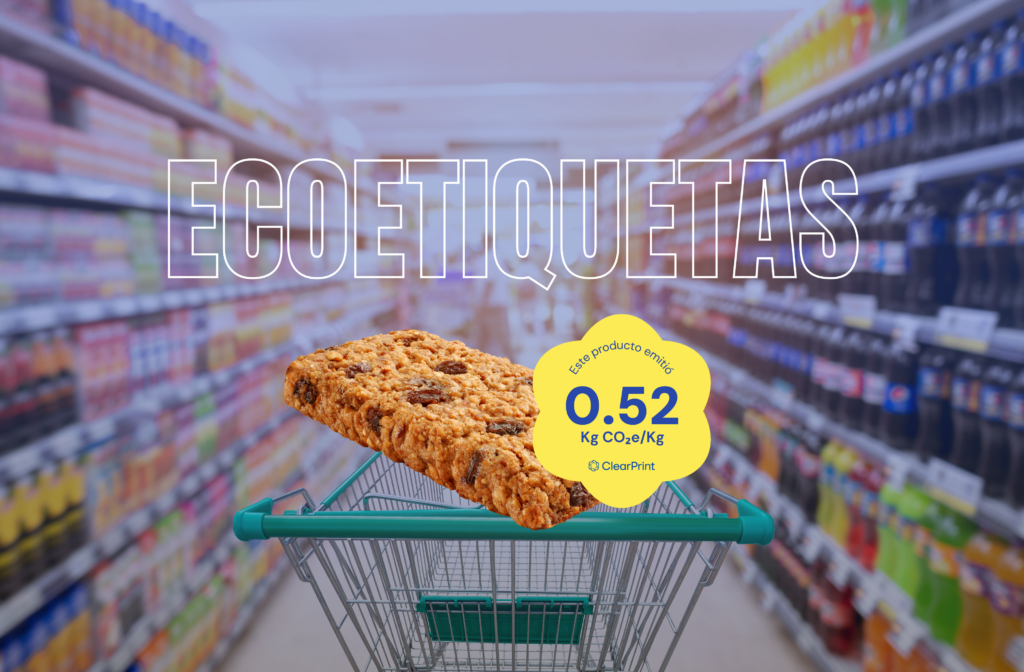
Imagine you're at the supermarket picking out products for your pantry. In front of you, you see eco-labels that don't just show the price or ingredients, but also clearly indicate how much greenhouse gas was emitted to get those products into your hands.
More and more consumers want to understand the environmental impact of what they buy every day. However, much of that information isn't usually visible on products. We often know what's in a food, but not the environmental impact of its production, transportation, or processing.
That's where eco-labels come in, playing an increasingly important role.
Eco-labels communicate a product's carbon footprint in a simple, visual way, helping people make more informed and conscious decisions.
What do eco-labels show?
ClearPrint eco-labels show how much greenhouse gas was emitted to produce a food and what its environmental impact was.
This is measured in CO₂ equivalent (CO₂e), a unit that allows different greenhouse gases to be compared on the same scale. This makes it easier to understand the climate impact of different food products.
Consumers no longer look only at price or taste. More and more people consider factors like sustainability, transparency, and environmental responsibility when they shop. That's why providing clear, well-supported information can make a real difference for both consumers and businesses.
The impact of our shopping choices
We often think individual choices have little impact. But when millions of people start choosing more sustainable products, industries start to change too.
Imagine the cumulative impact if we, as consumers, chose products with a smaller carbon footprint. It wouldn't just benefit the planet; it would also encourage companies to adopt more responsible, efficient, and sustainable processes.
Environmental transparency helps create a virtuous cycle where consumers and businesses can move together toward a more conscious food industry.
Eco-labels also make genuine sustainability efforts visible and help avoid vague or unclear environmental claims.
A shift that's already underway
In many international markets, especially in Europe, eco-labeling and carbon footprint communication are becoming increasingly important in the food industry.
In Chile, environmental awareness also continues to grow. More and more people want to understand how their purchasing decisions affect the planet and are looking for brands that provide clear, transparent information.
That's why tools like eco-labels will likely become more and more common in supermarkets and on consumer goods.
Eco-labels are transforming the way people understand the environmental impact of the products they buy.
Discover our news story: “¿Qué son las ecoetiquetas?” and find out how this tool drives more transparent, sustainable decisions.
Follow us on our Instagram so you don't miss any updates.
At ClearPrint, we help food companies measure and communicate their environmental impact through eco-labels and carbon footprint measurement. Want to learn more? Get in touch.