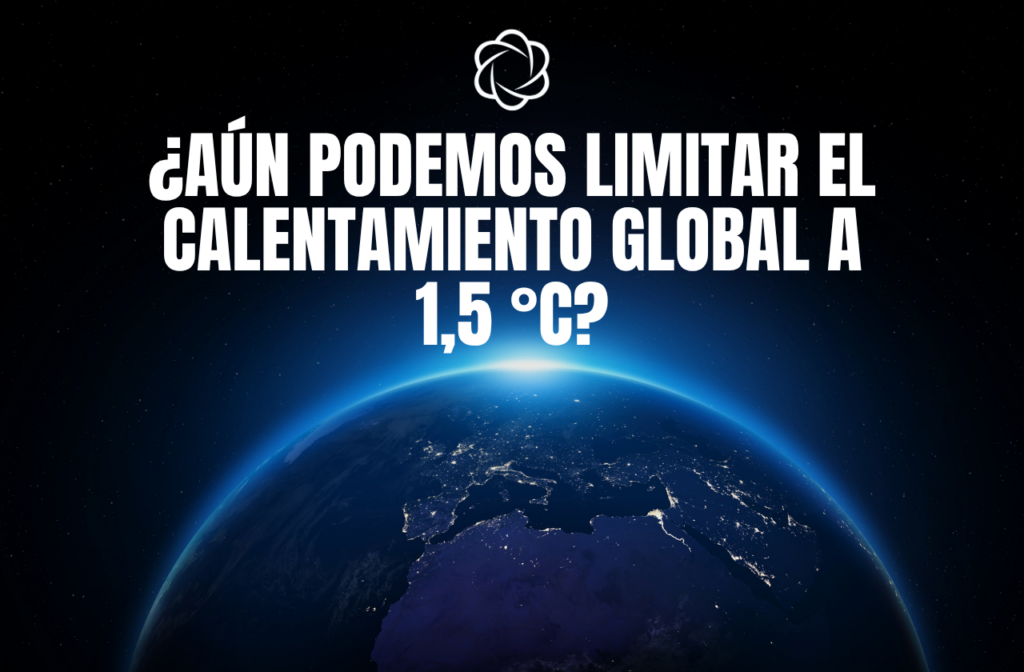
For years, limiting global temperature rise to 1.5°C above pre-industrial levels has been one of the main goals of international climate action. However, a new report from the United Nations Environment Programme (UNEP) warns that temporarily exceeding this threshold is now considered virtually inevitable.
This does not mean the goal has lost its importance or that efforts to reduce emissions are futile. On the contrary: Every fraction of a degree we can prevent matters. and the decisions we make during this decade will be crucial in determining how much temperatures rise and how long we remain above the 1.5°C threshold.
Exceeding 1.5°C Doesn’t Mean All Is Lost.
Global warming is not an all-or-nothing scenario. Exceeding 1.5°C does not mean it makes no difference whether we reach 1.6°C, 1.8°C, or even higher temperatures.
As global temperatures rise, the risks associated with extreme weather events, melting glaciers, ecosystem loss, and sea-level rise also intensify. The report also warns that some impacts may be irreversible, even if temperatures subsequently decline.
That’s why every additional rise in temperature we manage to prevent can make a difference for people, ecosystems, and the economy.
Our Decisions Can Change the Outlook.
The UNEP report highlights significant differences between possible global warming pathways.
Under currently implemented policies, the central projection puts global warming at approximately 2.6°C by 2100.
By contrast, in one of the most optimistic scenarios considered by UNEP, which assumes the full implementation of climate commitments and net-zero emissions targets, the central estimate peaks at around 1.8°C.
These figures do not represent an inevitable future. They illustrate something fundamental: the decisions we make today can change the trajectory of global warming.
Reducing Emissions Remains the Priority.
To limit the extent and duration of the overshoot beyond 1.5°C, the report highlights the need for rapid, deep, and sustained reductions in greenhouse gas emissions throughout this decade.
This includes moving toward net-zero CO₂ emissions during the 2050s and significantly reducing other greenhouse gases, especially methane from sectors such as fossil fuels, agriculture, and waste.
The action we take now is especially important. According to UNEP, the decisions made during this decade will determine the options available to us in the future to gradually bring temperatures down and move closer to the 1.5°C target once again.
Measure to Identify Where We Can Reduce
For a company, reducing emissions starts with understanding where they are being generated.
Measuring the carbon footprint makes it possible to quantify the greenhouse gas emissions associated with a product or organization, identify the main sources of impact, and gather the information needed to guide emission reduction strategies.
In this way, measurement becomes more than just a calculation exercise; it becomes a starting point for decision-making:
Measure → Identify → Reduce
In a context where emissions reductions are becoming increasingly urgent, reliable information enables organizations to take data-driven action and assess where concrete opportunities for improvement exist.
Every tonne of CO₂e we prevent matters.
The report’s message is clear: approaching or even temporarily exceeding 1.5°C does not mean we should stop taking action. Every tonne of CO₂e we can prevent matters. And so does every fraction of a degree of warming we can avoid.
En At ClearPrint, we help companies measure the carbon footprint of their products and organizations and turn that data into actionable insights to make better decisions. Because understanding our impact is the first step toward reducing it.
Source: United Nations Environment Programme (UNEP), Limiting Overshoot.
Discover our news story: Alimentación sostenible: ¿comer saludable significa cuidar el planeta?.